
Stop Waiting: Spot Spirit Guide Signs in 2 Minutes a Day

Yes, spirit guides typically communicate through subtle signs and synchronicities rather than dramatic announcements. A reliable sign tends to repeat, arrive at meaningful moments, and carry a felt sense of recognition rather than a meaning you had to talk yourself into. Your next step is simple: ask for one specific sign, then start a one-line journal entry each day to track what shows up.
Key Takeaways
- Repeating numbers like 111 or 444 often indicate themes of new beginnings or reassurance, especially when they appear during uncertain times.
- Specific signs such as feathers, animal encounters, or memorable dreams tend to show up in meaningful moments, particularly after a decision or loss.
- Asking for a clear, specific sign and journaling daily for several days enhances the chance of accurately recognizing genuine guidance signals.
- The “inner click” feeling of recognition and repetition over days are more reliable indicators than isolated signs or wishful interpretations.
- Consistent daily habits like brief journaling and setting intentions significantly improve your ability to notice and interpret signs from spirit guides.
Table of Contents
- What Are the Common Signs Spirit Guides Use?
- How Do You Ask for a Sign?
- How Do You Know a Sign Isn’t Just Coincidence?
- What Daily Habits Help You Notice Signs More Clearly?
- What Are the Warning Signs of a False or Misleading Message?
- When Does a Phone Reading Help You Interpret a Sign?
- Do Different Types of Spirit Guides Send Different Signs?
- How Have Different Cultures Understood Spirit Guide Signs?
- Beyond Signs, How Else Do Spirit Guides Communicate?
- How Do You Read a Sign That Feels Mixed or Unclear?
- How Can You Deepen Your Connection to Receive Clearer Guidance?
- Our Take: Stop Waiting for Fireworks
- Need Help Making Sense of a Sign Right Now?
- Sources
What Are the Common Signs Spirit Guides Use?
Spirit guides tend to work with what already surrounds you: numbers, animals, dreams, and the small physical sensations you’d otherwise dismiss. Once you know the categories, patterns that felt random before start looking intentional.
Guides commonly communicate through repeating numbers, feathers, animal encounters, dreams, synchronicities, temperature changes, ringing ears, and intuitive nudges. Here’s how those categories tend to show up in everyday life:
- Repeating numbers and sequences. Seeing repeating numbers such as 111, 222, or 444 on clocks, receipts, and license plates often points to a theme rather than a single message. Master numbers like 444 often signal stability or reassurance during a rocky stretch, while 111 tends to mark new beginnings.
- Unexpected objects and feathers. A feather on your doorstep or a coin in an odd spot means little on its own. It becomes worth noticing when it shows up right as you’re wrestling with a decision.
- Animal encounters and nature signifiers. Butterflies, dragonflies, and birds that behave unusually around you (landing close, circling, appearing repeatedly) often get read as visitation signs, especially after a loss.
- Vivid or visitation dreams. Dreams that feel sharper and more coherent than ordinary dreaming, especially ones involving someone who has passed, often carry a direct message rather than random mental static.
- Sudden ideas or claircognizant hits. An answer that arrives fully formed, with no reasoning process behind it, is a hallmark of claircognizance, one of the intuitive “clairs” practitioners track.
- Physical sensations. Chills, tingling along the arms, or a sudden temperature shift in a room are common enough that most guides working with energy will lean on them as a quick “yes” signal.
- Songs and recurring phrases. A song that plays repeatedly, or a phrase that keeps surfacing in conversation and text, often lines up with whatever question you’ve been sitting with.
How Do You Ask for a Sign?
Asking works better when you’re specific about the sign but open about the outcome. Vague requests produce vague, hard-to-verify results. A tightly defined ask, on the other hand, is easy to confirm when it actually happens.
- State a clear, one-sentence request. Something like, “If this job change is right for me, show me a yellow butterfly soon,” gives you something concrete to check against.
- Choose a unique confirmation, not a generic one. A red feather or the phrase “trust the timing” works better than “give me a sign,” which is too broad to ever rule out.
- Ground yourself first. Spend one to two minutes on slow breathing before you ask. A quiet nervous system notices more than a distracted one.
- Name the intention, then release it. Say the request once, in your head or out loud, and let go of controlling how or when it arrives.
- Journal for three to seven days. Write down what you asked and check daily for anything matching, even loosely.
Choosing a sign that is specific but still open keeps you from either scripting the outcome or missing it entirely.
Pro Tip: Add a short line of gratitude after you journal, even before the sign appears. Practitioners who track this consistently report that thanking your guides in advance seems to increase how often signs show up, not just how easily you notice them.
How Do You Know a Sign Isn’t Just Coincidence?
The clearest signal is what practitioners call the “inner click,” an immediate sense of recognition or certainty that arrives before your rational mind starts building a story around it. That instant reaction is far more trustworthy than a meaning you construct after the fact, once you’ve had time to talk yourself into it.
A few checks help sort real signs from wishful thinking:
- Timing and relevance. A sign that lands right after you’ve asked a question or made a decision carries more weight than something you notice at random.
- Repetition across days. One butterfly means nothing. Three unusual butterfly encounters in a week, tied to the same question, means something.
- Emotional tone. Genuine guidance tends to feel calm and supportive. Messages that flatter you or pressure you toward urgency deserve more scrutiny.
- Repeat confirmation. Ask for the same sign again, or a slightly different one, and see if the pattern holds before you act on anything major.
Synchronicity, the term Carl Jung used for meaningful coincidence, is the right framework here: it’s not that the event is statistically impossible, it’s that its timing lines up with your inner state in a way pure chance rarely does.
What Daily Habits Help You Notice Signs More Clearly?
Noticing is a skill, not a personality trait, and it improves with repetition. Most people who feel like guides “never talk to them” simply aren’t tracking closely enough to catch the pattern.
- Keep a one-line daily journal. Note what you asked for, what you noticed, and how it felt. This single habit does more to build evidence than any single dramatic experience.
- Run a short check-in. Spend two to five minutes each morning or evening setting intention and reviewing what showed up. A structured routine like the Examen prayer offers a simple format for this kind of daily reflection.
- Review weekly for patterns. Scan your notes every seven days for repeating numbers, songs, animals, or objects you might have missed day to day.
- Book a reading if signs feel persistent but unclear. When the same sign keeps showing up and you can’t land on a meaning, outside interpretation can save weeks of guessing.
What Are the Warning Signs of a False or Misleading Message?
Not every dramatic feeling is trustworthy, and genuine guidance rarely pressures you. Watch for these red flags:
- Ego-flattering content. Messages that tell you exactly what you want to hear, with no nuance, are worth questioning.
- Fear-based urgency. Real guidance rarely demands immediate action or threatens consequences for waiting.
- Secrecy or isolation. Any message insisting you tell no one is a signal to slow down.
- Zero cross-check with reality. Medical, legal, or financial decisions need professional verification, no matter how strong a sign feels.
When in doubt, breathe, delay the decision until a pattern confirms itself, and reread your journal to see if you’re projecting a hope onto an ordinary event.
When Does a Phone Reading Help You Interpret a Sign?
A short phone reading works best when you’ve already gathered a pattern (a repeated number, a recurring dream, a sign that won’t quit) but can’t land on what it means. On a typical call, a reader listens to your notes and helps connect the pattern to your actual situation instead of guessing blind.
Come prepared with your journal, the timing of the pattern, and one concise question. Phonepsychicreaders vets its readers closely and keeps spiritual guidance readings available around the clock, so you’re not stuck waiting on a sign to make sense on your own.
Do Different Types of Spirit Guides Send Different Signs?
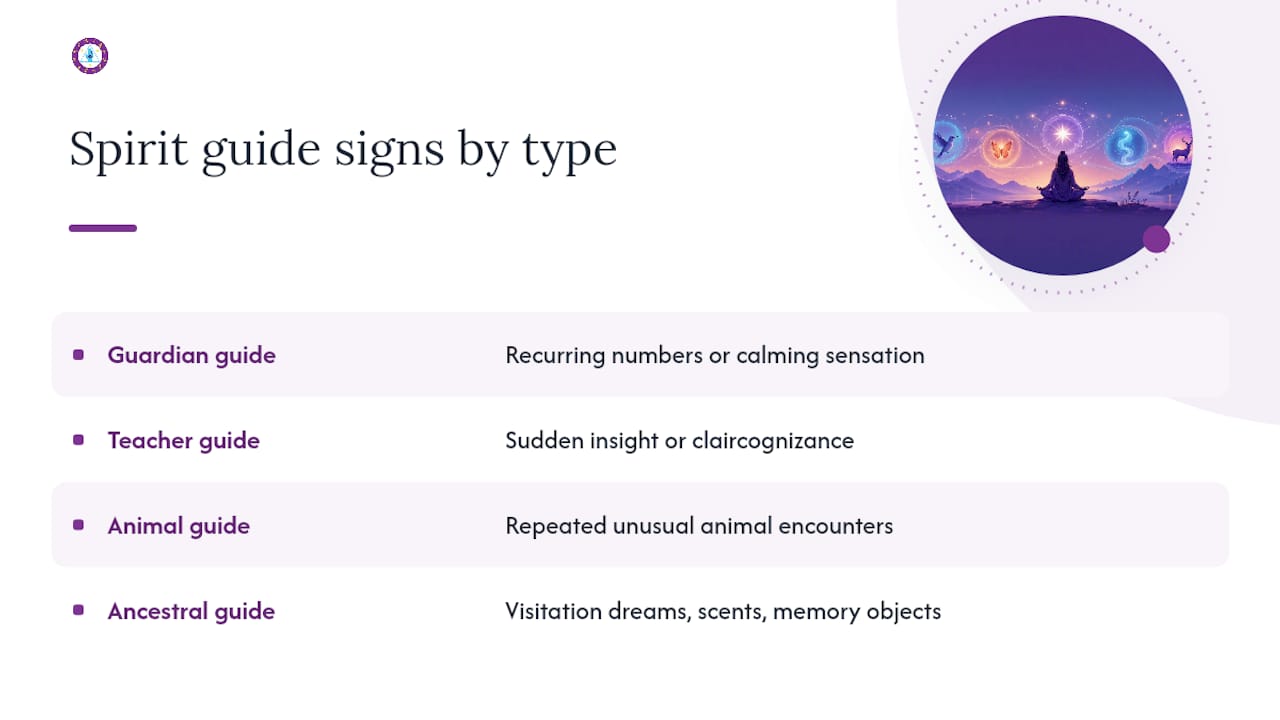
Not every guide communicates the same way, and knowing the type can help you read the sign correctly. A guardian guide, often described as a lifelong companion, tends to lean on consistent, calming signals: recurring numbers, a steady physical sensation, or a familiar song that shows up during hard stretches.
Teacher guides, who tend to appear during a specific growth period, often communicate through sudden insight or claircognizant hits rather than nature signs. If you’ve had a flash of clarity that reshaped how you see a problem, that pattern fits a teacher guide more than a symbolic object might.
Animal or totem guides typically show up through actual animal encounters, especially the same species appearing repeatedly in unusual circumstances. Ancestral or departed loved ones tend to lean on visitation dreams, specific scents, or objects tied to shared memories, since the connection is personal rather than symbolic.
Grasping which category a guide falls into matters because it changes what you should expect. If you’re waiting for a dramatic animal encounter from a teacher guide who prefers sudden insight, you might miss the message entirely while looking in the wrong direction.
How Have Different Cultures Understood Spirit Guide Signs?
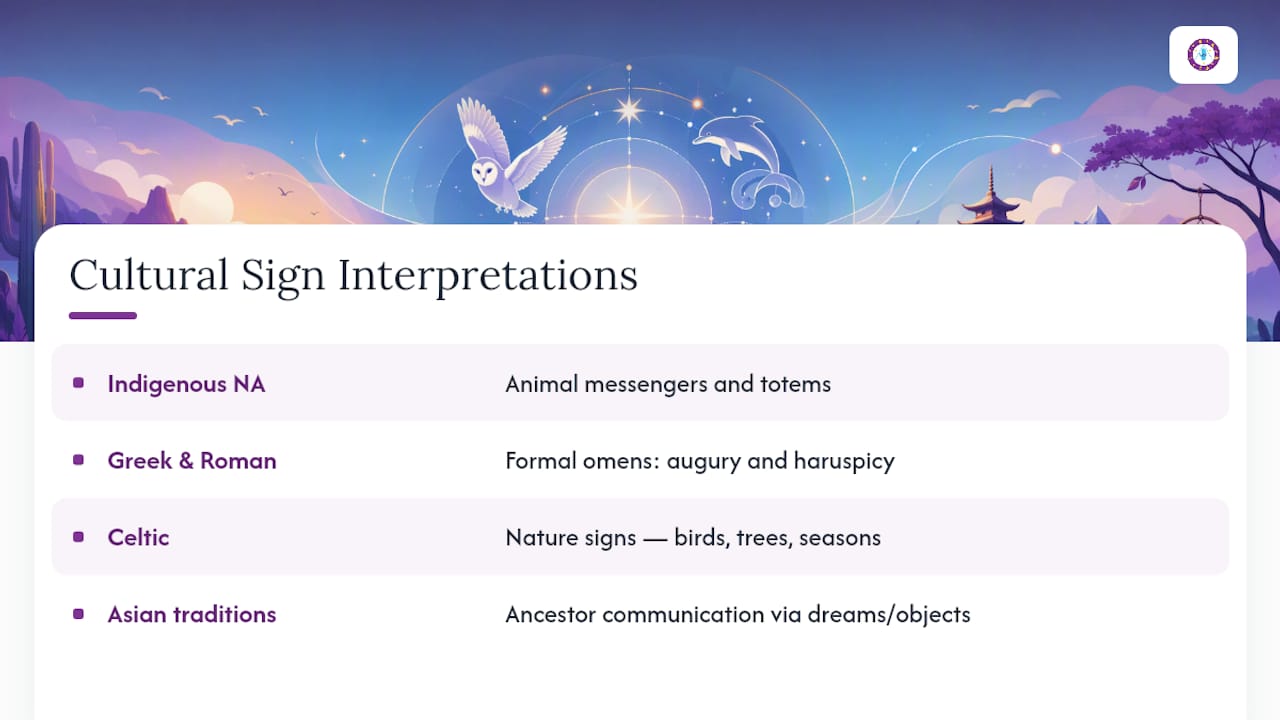
Reading meaning into everyday signs isn’t a modern invention. Many Indigenous traditions across North America describe animal messengers and totem relationships as central to spiritual life, with specific species carrying specific meanings passed down through generations.
Ancient Greek and Roman traditions built entire practices around omens: augury (bird flight patterns) and haruspicy (interpreting animal organs) were formal, respected methods of reading divine intent, not fringe beliefs. Celtic traditions leaned heavily on nature signs, tying particular birds, trees, and seasonal changes to spiritual messages.
In many Asian spiritual traditions, ancestor communication through dreams and specific objects has been documented for centuries, often tied to formal remembrance practices rather than casual interpretation.
What ties these traditions together is a shared assumption: the physical world and the spiritual one aren’t separate, and ordinary events can carry intentional meaning when the timing and context line up. Modern practitioners didn’t invent this framework. They inherited it, then adapted the vocabulary (numbers, feathers, claircognizance) to a culture more comfortable talking about “signs” than omens or ancestor visits.
Beyond Signs, How Else Do Spirit Guides Communicate?
Signs are the most visible form of guidance, but they’re rarely the only channel. Feelings are often the quietest and most consistent one: a sense of peace around a decision, or unexplained unease about a path that looks fine on paper, frequently functions as guidance without ever producing an external sign.
Visions, whether during meditation, right before sleep, or in the seconds after waking, tend to arrive as fragments rather than full scenes. A flash of a place, a face, or a color can carry weight even without a clear storyline attached.
Synchronicities work a level above single signs. Where a sign is one event, a synchronicity is a cluster: multiple unrelated things pointing toward the same theme within a short window. That clustering is what separates a meaningful coincidence from an isolated one, and it’s the piece most people overlook when they’re hunting for one big dramatic moment instead of noticing the smaller convergence happening around them.
Body-based knowing (claircognizance and clairsentience) rounds this out. Some people get information as pure knowing with no source, others get it as a physical feeling in the gut or chest. Neither is more legitimate than the other. They’re just different receiving styles.
How Do You Read a Sign That Feels Mixed or Unclear?
Ambiguity usually means one of two things: you’re getting more than one message layered together, or you don’t have enough pattern data yet to interpret it correctly. Neither is a dead end.
Start by separating the sign from your emotional state at the time. A crow encounter that felt ominous on a stressful day might read completely differently once you revisit it calmly a day later. Write down the raw event first, without the interpretation, so you can reread it later with fresh eyes.
If a sign seems to contradict an earlier one, look for a timing gap. Guidance often shifts as circumstances shift, so an earlier “wait” sign followed by a later “move forward” one isn’t necessarily a contradiction. It may reflect a genuine change in what’s best for you now.
When a sign still won’t resolve after a few days of journaling, ask for one more, narrower confirmation rather than forcing meaning onto what you already have. Testing for repetition and checking emotional tone before acting protects you from overreacting to noise or dismissing something real out of frustration.
How Can You Deepen Your Connection to Receive Clearer Guidance?
Reception improves with consistency far more than with intensity. A daily two-minute check-in beats an occasional hour-long meditation session for most people building this skill.
Short, structured quieting practices help create the internal stillness signs need to register. Simple breathing and meditation techniques borrowed from broader wellness practice work well here, since the goal is the same: quiet the mental noise long enough to notice what’s already there.
Gratitude plays a bigger role than most people expect. Thanking your guides for signs you’ve already received, rather than only asking for new ones, tends to keep the channel more open. Acting on small nudges (the ones that feel almost too minor to matter) signals that you’re actually paying attention, which seems to encourage more, not fewer, signs over time.
Our Take: Stop Waiting for Fireworks
Most advice on this topic oversells the dramatic sign and undersells the boring daily habit that actually works: writing one line down every day. The research on this is consistent. Journaling is the most practical verification tool precisely because it removes the retrospective bias that makes every coincidence feel meaningful once you’re already looking for one.
The conventional advice treats sign-spotting as something that happens to you. It doesn’t, really. It’s closer to a trained attention skill, the same way a birdwatcher notices species a casual walker misses simply because they know what to look for. Prioritize the two-minute daily check-in and the one-line note over waiting for something unmistakable to happen. If you do that for a week and still can’t make sense of a repeating pattern, that’s exactly when outside interpretation earns its place, not as a replacement for your own noticing, but as a second set of eyes when your own has gone in circles.
— Jason
Need Help Making Sense of a Sign Right Now?
Some phone psychic services get you a live reader on the phone in minutes, not a scheduled appointment days out, when a pattern won’t stop nagging at you. Many readers go through vetting processes, and some lines are staffed 24/7, so a 2 a.m. dream you can’t shake doesn’t have to wait until morning to get looked at.

People usually call in after a repeating number or an unusual dream has shown up enough times that it stops feeling random. Before you dial, pull up your journal notes, jot down the pattern’s timing, and settle on one concise question so the call gets straight to what you actually need answered. If the sign relates to a bigger crossroads, whether that’s a relationship, a move, or a career shift, a spiritual guidance reading is built exactly for that kind of interpretation, with pay-per-minute pricing and no long-term commitment attached. Pick up the phone and get a second set of eyes on what you’ve been noticing.
Sources
- Spirit Guides Signs: 15 Ways Your Guides Communicate With You
- Types of spirit guides and how they communicate (mindbodygreen)